






How Inleads IT Saved 15 Hours a Week on Client Reporting
The 15-Hour Problem Hiding in Every Agency’s Week
Every Friday afternoon, the account managers at Inleads IT — a 22-person remote marketing agency — used to disappear into a familiar ritual: exporting timesheets, cross-checking them against project notes, formatting spreadsheets, and writing explanations for every hour billed. By the time the invoices went out, nearly 15 hours of unbillable work had gone into simply proving that the billable hours were real.
And even then, clients pushed back.
If this sounds familiar, you’re not alone. For agencies running on hourly or retainer billing, client reporting is often the single biggest hidden cost of doing business — and the most common source of client churn.
The Problem: Clients Didn’t Trust the Billable Hours
Inleads IT’s account director summed up the core issue simply: “We weren’t losing clients because of bad work. We were losing them because they couldn’t see the work.”
The symptoms were textbook:
- Invoice disputes every month. Clients questioned line items because a timesheet entry like “Content strategy – 3 hrs” told them nothing about what actually happened.
- Manual report-building consumed entire afternoons. Account managers pulled data from three different tools, then manually built PDFs and slide decks to “prove” the hours.
- Trust eroded gradually. Without visibility, clients began assuming padding, even when none existed — a perception problem that no amount of over-explaining could fully fix.
- Renewal conversations turned defensive. Instead of showcasing results, account managers spent renewal calls justifying timesheets.
This is a pattern common across agencies of every size: the work is good, but the proof of work is invisible, inconsistent, or too labor-intensive to produce regularly.
The Solution: A Transparent, Automated Client Portal
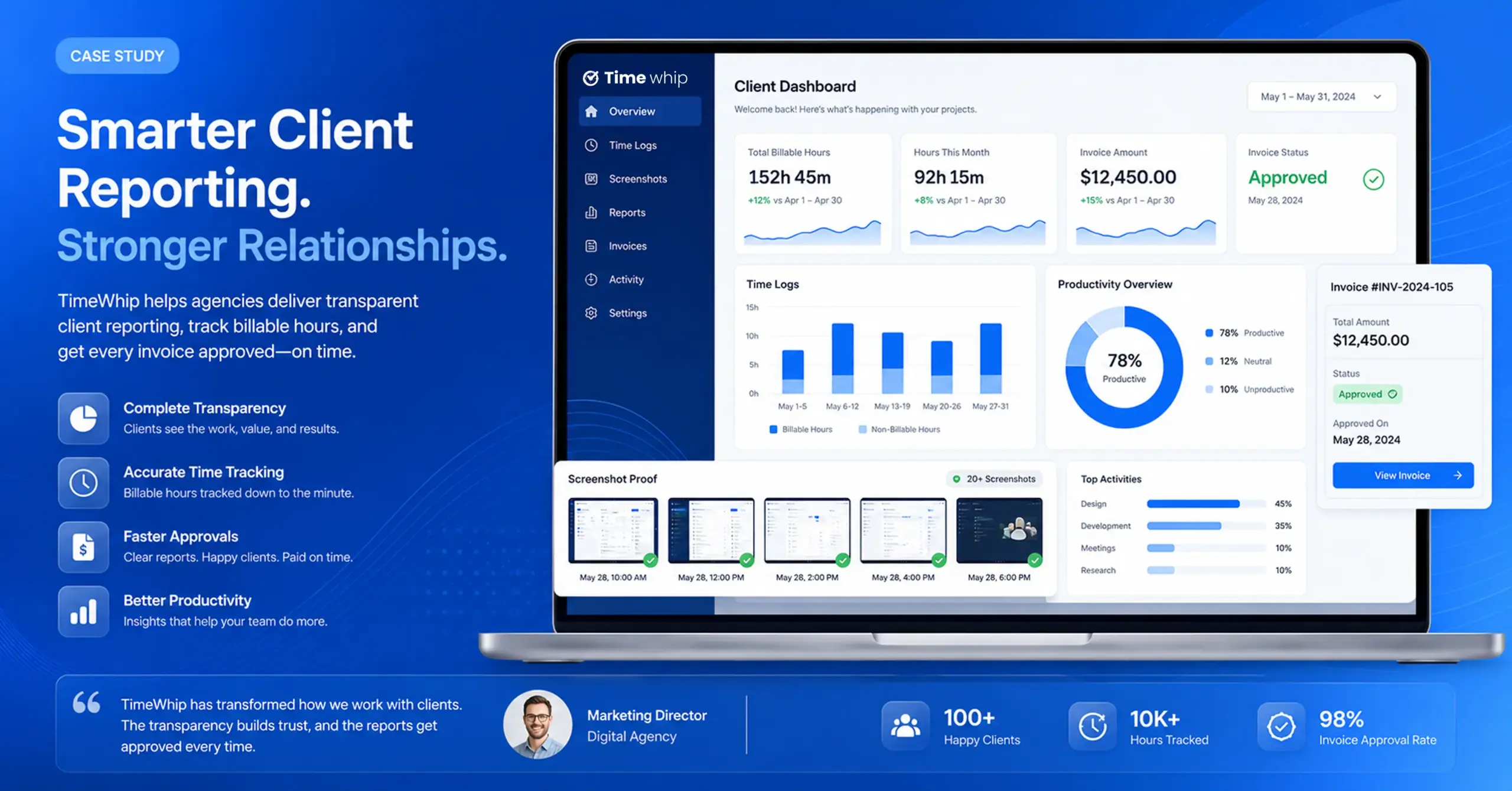
Inleads IT moved its entire team onto TimeWhip, specifically to use its Client Portal and AI-powered reporting layer — features built to solve exactly this trust gap.
Here’s what changed operationally:
1. Time Tracking Tied Directly to Projects and Clients
Every hour logged in TimeWhip is automatically linked to the relevant project and client — not a generic task label. Account managers no longer had to manually map timesheets to deliverables after the fact.
2. Context-Rich Activity, Not Just Numbers
Instead of a bare number of hours, the Client Portal shows the actual context behind the time: which tasks were active, when work happened, and how it maps to agreed deliverables — giving clients a fuller picture without exposing sensitive internal details.
3. AI-Generated Reports, Not Manual Ones
Rather than someone spending an afternoon building a report, TimeWhip’s reporting engine compiles activity data into a clean, white-labeled, client-ready report automatically — cutting report preparation from hours to minutes.
4. Client Self-Service Visibility
Clients were given direct portal access, so they could check progress themselves at any time — removing the “just trust us” dynamic entirely and replacing it with an always-available source of truth.
5. Consistent, Recurring Delivery
Reports were scheduled to generate and deliver automatically on the same day every week, replacing an ad-hoc process that used to depend on which account manager remembered to build it.
The Result: 15 Hours Back and 100% Invoice Acceptance
Within the first full billing cycle after rollout, Inleads IT saw measurable change:
| Metric | Before TimeWhip | After TimeWhip |
| Time spent building client reports | ~15 hrs/week | Under 1 hr/week |
| Invoice disputes per month | 4–6 | 0 |
| Invoice acceptance rate | ~78% | 100% |
| Client portal logins (self-service checks) | 0 | Weekly, per client |
| Renewal conversation tone | Defensive | Results-focused |
The account director’s take on the shift: “The moment clients could see it themselves, the conversation changed completely. We stopped defending hours and started discussing strategy.”
By removing the manual reporting bottleneck, Inleads IT didn’t just save time — it recovered almost two full working days per week across the team that could be redirected toward actual client strategy and delivery.
Why This Works: The Psychology of Billable-Hour Trust
Clients don’t distrust agencies because agencies are dishonest. They distrust invoices because hours are abstract and trust requires visibility. A timesheet says what was billed. A transparent portal shows why it was billed — in near real time, without anyone having to ask.
This is the core principle behind TimeWhip’s Client Portal: transparency isn’t a reporting feature, it’s a trust mechanism that runs continuously in the background of every project.
How to Apply This to Your Own Agency
If your team is spending hours every week justifying timesheets instead of using that time to serve clients, the fix isn’t more explanation — it’s better visibility. Agencies typically see the fastest wins by:
- Linking every tracked hour to a specific client and project from day one, not retroactively.
- Giving clients direct, self-service access to their own activity and reporting data.
- Automating recurring reports so delivery isn’t dependent on someone remembering to build them.
- Replacing raw timesheets with context — what was worked on, not just how long.
Ready to Stop Justifying Your Invoices?
TimeWhip’s Client Portal turns billable-hour transparency into an automatic byproduct of how your team already works — no extra reporting effort required.
FAQ
How does TimeWhip’s Client Portal build client trust?
It gives clients direct, real-time visibility into tracked activity tied to their specific project, replacing static timesheets with continuously updated, self-service reporting.
Does TimeWhip automate client reports?
Yes. TimeWhip’s AI-powered reporting compiles activity and time data into white-labeled, client-ready reports automatically, removing manual report-building from an agency’s workflow.
Is TimeWhip suitable for agencies billing hourly or on retainer?
Yes. Because time is tracked against specific projects and clients, TimeWhip supports both hourly billing transparency and retainer-based reporting needs.
How much time can agencies typically save on client reporting?
Agencies moving from manual, spreadsheet-based reporting to automated portal reporting commonly report reclaiming 10–15+ hours per week, depending on team size and client volume.