






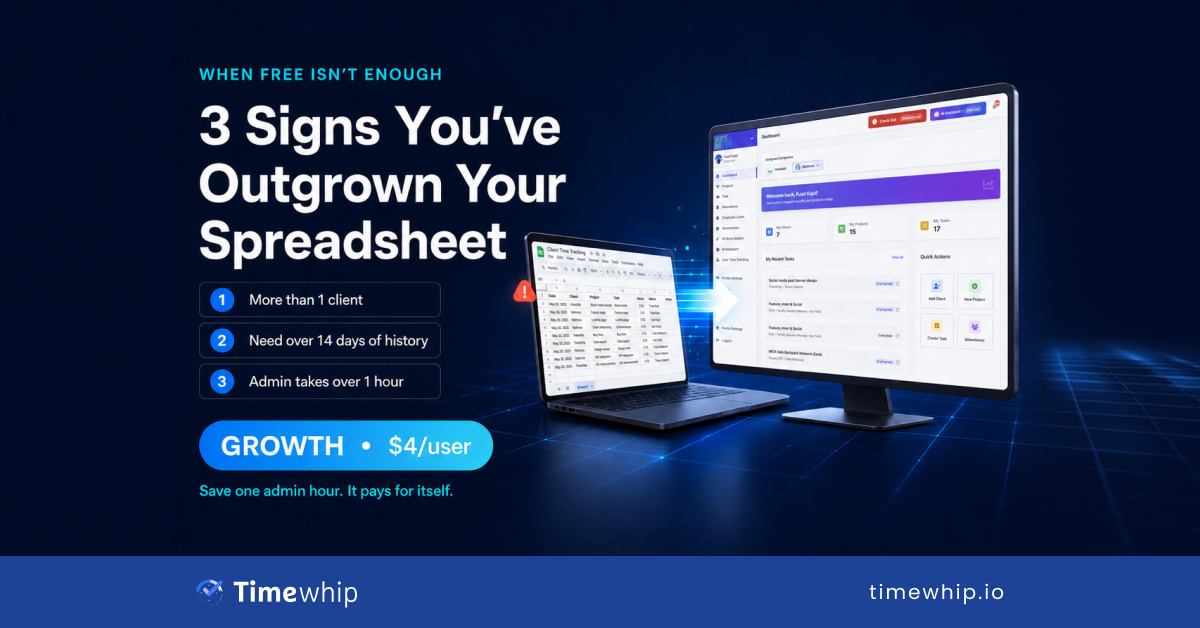
When Free Isn’t Enough: 3 Signs You’ve Outgrown Your Spreadsheet.
If you’re still logging hours in a spreadsheet — or leaning on a free time tracker to hold your growing team together — you already know the cracks are starting to show. Free tools and basic spreadsheets are great for getting started. They are not built to scale with you.
Here are three clear signs your business has outgrown the free version of time tracking, and why the upgrade to TimeWhip’s Growth plan pays for itself in less time than it takes to read this article.
Sign #1: You’re Managing More Than One Client (and the Starter Plan Won’t Let You)
Spreadsheets don’t care how many clients you have. Free and Starter-tier tools do — and usually not in your favor.
Most entry-level time tracking plans, including TimeWhip’s Starter tier, cap you at a single client. That works fine when you’re freelancing solo or piloting a new process. But the moment you take on a second client, a second retainer, or a second internal department, you’re forced into one of two bad options:
- Juggle multiple spreadsheets or tools to keep clients separate, risking mixed-up hours and reporting errors
- Manually tag and sort every time entry by client after the fact, burning hours you could’ve billed
Every additional client you manage outside a proper system is additional admin risk — misattributed hours, delayed invoices, and reports that don’t hold up when a client asks “where did this number come from?”
The fix: A plan built for multiple clients and projects out of the box, with automatic tagging so nothing gets miscategorized.
Sign #2: Your Data Disappears Before You Need It (14-Day Retention Isn’t Enough)
Here’s a scenario every growing team eventually hits: a client disputes an invoice from three weeks ago, or you need to pull a quarterly productivity trend for a board meeting — and the data’s already gone.
A 14-day retention window sounds generous until you actually need historical data. Common situations where 14 days falls short:
- Monthly client billing cycles, where you need screenshots and logs from the entire month, not just the last two weeks
- Performance reviews or productivity audits that look at 30-, 60-, or 90-day trends
- Dispute resolution, where “prove it” requires evidence from weeks ago, not days
If your retention window is shorter than your billing cycle, you’re not actually protected — you’re one late invoice away from having zero evidence to back it up.
The fix: Extended retention that matches how your business actually operates — monthly, quarterly, and beyond.
Sign #3: You’re Still Doing Manual Reporting (And It’s Costing You More Than $4)
This is the sign that quietly costs the most money.
Every week, someone on your team is likely doing some version of this: exporting time logs, cross-checking them against project hours, formatting a spreadsheet, and emailing it to a client or manager. Add up the actual time spent:
- Pulling and cleaning raw time data: ~20 minutes
- Cross-referencing against project budgets: ~15 minutes
- Formatting into a client-ready report: ~15 minutes
- Back-and-forth clarifying discrepancies: ~10+ minutes
That’s an hour of admin work, conservatively, for a single reporting cycle — repeated weekly or monthly, for every client.
Now compare that to the cost of upgrading. TimeWhip’s Growth plan is $4/user — meaning one hour of saved admin time pays for the entire upgrade, and every reporting cycle after that is pure time saved. AI-generated, white-labeled reports replace the manual export-and-format routine entirely, turning an hour of admin work into a single click.
The Real Cost of Staying Free
None of these signs show up as a line-item expense. There’s no invoice that says “cost of outgrown spreadsheet: $200.” Instead, the cost hides in:
- Hours spent on manual reporting instead of billable work
- Client trust eroded by reporting gaps or missing data
- Growth capped artificially at “however many clients your current tool allows”
Free and entry-level plans aren’t a mistake — they’re a starting point. The mistake is staying on them after your business has already moved past what they’re designed for.
Ready to Outgrow the Spreadsheet?
If any of these three signs sound familiar, it’s a strong signal your team is ready for a system built for growth, not just a starting point. TimeWhip’s Growth plan removes the client cap, extends your data retention, and automates the reporting that’s currently eating your week.